i.The definition
Every diamond is graded for colour — but most are graded on a scale of absence. The colourless scale runs from D (perfectly white) to Z (visibly tinted), and value falls as tint appears. A fancy colour diamond is what lies beyond Z: a diamond with so much natural colour that the colour itself becomes the point. At that moment the logic inverts — the more saturated the hue, the rarer and more valuable the stone.
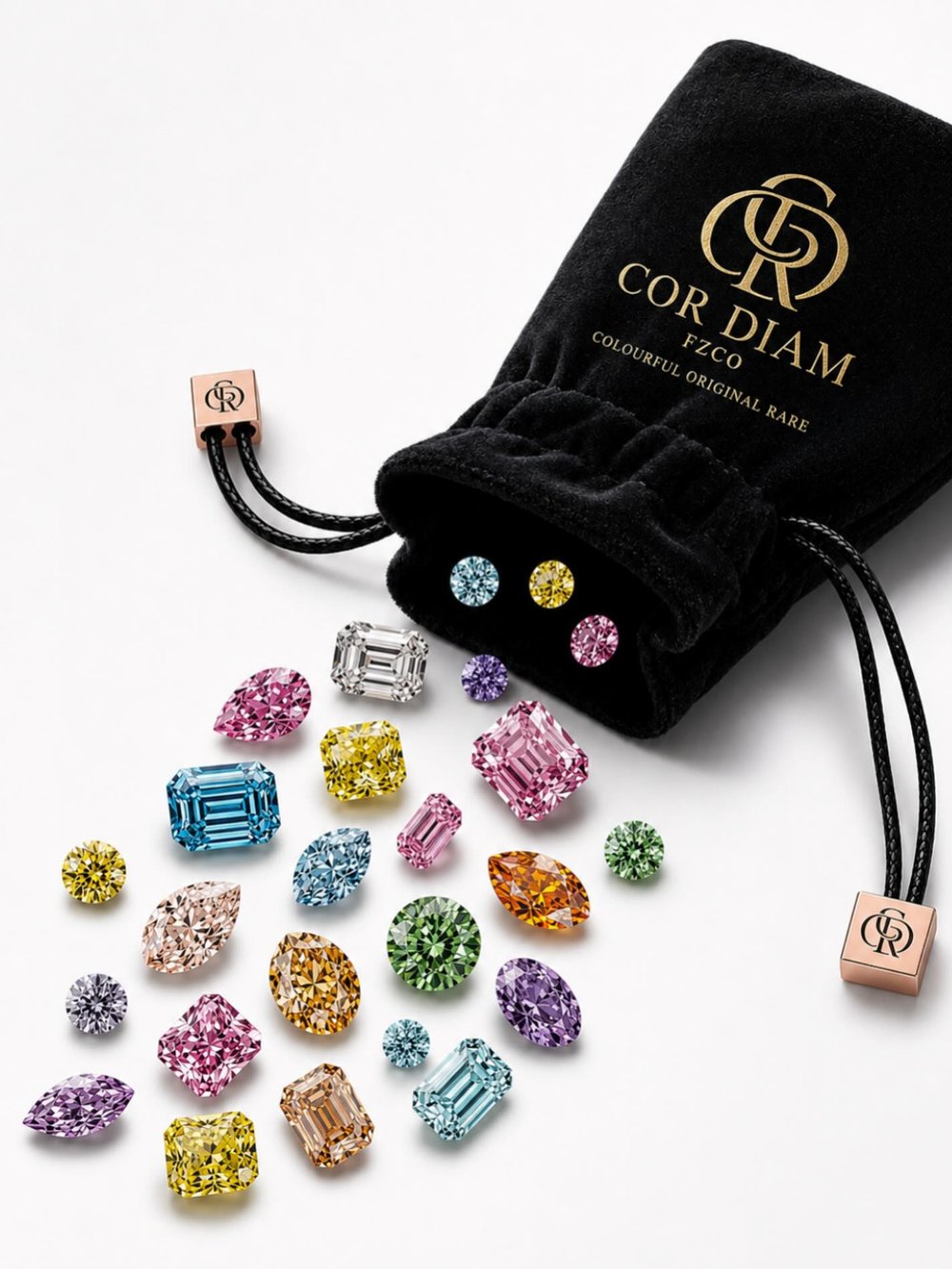
The GIA recognises twelve base hues — including pink, blue, yellow, green, orange, violet, red, brown, grey, black, and the endlessly collectible "champagne" browns — each modified by overtones and graded across nine levels of intensity, from Faint through Fancy Light, Fancy, Fancy Intense and Fancy Deep to the pinnacle: Fancy Vivid.
ii.How rare are they, really?
Of every ten thousand diamonds mined, roughly one shows natural fancy colour. Within that fraction, hierarchy reasserts itself immediately: yellows and browns are comparatively attainable; fine pinks are measured in stones, not parcels; and natural reds are so exceptional that a gem-quality red over one carat is a market event. Pure, unmodified colour — a pink with no brown overtone, a blue with no grey — is rarer still.
- Yellow & champagne — the most abundant fancy hues; the natural entry point to the category.
- Pink — dominated for forty years by a single source, Australia's Argyle mine, closed in 2020.
- Blue — roughly 0.02% of all diamonds mined; historically from India's Golconda and South Africa's Cullinan.
- Green, orange, violet — true rarities; green forms over millions of years of natural irradiation.
- Red — the apex. Most known reds are under one carat.
iii.How they are graded
For coloured diamonds, the 4Cs are reordered. Colour is paramount — assessed across three dimensions:
| Dimension | What it measures | Why it matters |
|---|---|---|
| Hue | The dominant colour — pink, blue, yellow — plus any modifying overtone | Pure hues command the strongest premiums; a "purplish pink" differs from a "brownish pink" in both beauty and price |
| Tone | How light or dark the colour appears | Too light and the stone reads pale; too dark and it loses life |
| Saturation | The strength and depth of the colour | The single greatest driver of value — this is what separates Fancy from Fancy Vivid |
Cut follows colour: a master cutter shapes a coloured stone to concentrate and even out its hue, which is why fancy colours so often appear as radiants, cushions and pears rather than classic rounds. Clarity matters, but a vivid coloured stone with minor inclusions will still outrank a flawless stone of weak colour. Certification by GIA or IGI is non-negotiable — it is the only reliable way to confirm that colour is natural, not treated or laboratory-grown.
iv.Natural, treated, or grown — the distinction that decides value
Colour can be given to a diamond artificially: irradiation and high-pressure, high-temperature treatment can alter or deepen hue, and laboratory-grown diamonds can be produced in colour. These stones have their place in fashion jewellery — but they are not fancy colour diamonds in the collector's sense, and the market prices them a world apart. Natural origin, confirmed by an independent laboratory, is the foundation of everything — of rarity, of resale, and of the stone's behaviour as a store of value. Every stone the house trades is certified natural.
v.Where to go next
Colour is the subject; the causes are stranger than most expect. Continue to Chapter II — The Science of Colour ↗, or meet the stones themselves in the Gallery ↗.